Wednesday, June 20, 2012

Back into Brasil

The ride across eastern French Guiana was outstanding! We had an early start, which kept it cool, along with the rolling hills and lifting fog.


(road east of Cayenne)


(stop in Cacao, a Hmong community, which has a blazing market on the weekends, not so much when we were there. The town was super peaceful, full of friendly people, and nestled in what felt like tropical  mountains.)


(the ride to St Georges continued to be fantastic )

As we pulled into St Georges, we missed the national police building, going instead right to the water where boat drivers had already started vying (that is, yelling) for our business. We went into the customs building where they directed us to the proper place, about 6 blocks behind us. We didn’t have the clearest set of directions to operate from, and not only because our French is non-existent. As we sat at an intersection questioning which way to go, a police car pulled in front of us, we told them we were looking for them, and
they led us the last block to the national police building. At first we were sad to see a line of people waiting, then we were even sadder to see that they were closed from 12-2 and it was exactly 12:08. Well, I guess 2pm is better than 4pm, like the rest of the country’s businesses. but as we were standing there talking, a lady opened the door and asked if we just needed a stamp. We were let in, stamped out, and on our way in less than 5 minutes. Sweet! The best part about France is that there’s no import docs for the bike, which made this crossing a breeze.

Back to the boat guys… The one in the street we spoke with asked for 60 euros to cross the river. That’s insane. We hoped to pay 20, expected more like 30 (based off of other travelers amounts paid, the cost of the infrequent ferry, and the going rate of 5 euro per passenger). Let the bartering begin. With me speaking Spanish, the boat driver Portuguese (much better for us than French), we finally agreed on 30. Good. Or so  we thought.


(the TA ready to load)

I assumed, but didn’t establish, that the price would include getting the bike into the boat, then getting her across the river and to the other side. The expectation was to pay more helpers. Aaarrgghhh. 2 of them wanted 10 euros each. Nope. Not gonna happen. After deliberation, us putting our helmets on to go talk to other drivers, and much time, we finally got a total price of 35 euros, all included. More than it should be.   But that’s what it was. (This is especially expensive not only because of the short distance across, but also because of the bridge that is built, but impassable. See below for more info)


(Mike likes riding the TA over water)

After the 5 minute boat ride, we arrived in Brasil! We unloaded (with the kind help of a Brazilian man at the dock who didn’t shake us down for money, but was content with a big ´thank you´ and a handshake) in a small town 5-10km north of Oiapoque, where we needed to get for customs and immigration.


(the tiny town where we unloaded felt immediately more like Latin America than anywhere we’ve been in months)


(bar and shopping all in one)


(on the way to Oiapoque)


(This is not the bridge that we could have used to cross the river…)


(…this is.)

This completely finished, modern bridge is impassable due to some political dispute. It was completed in 2011, supposed to be opened in 2012, now some say early 2013. But the hold up is political, not technical, so who knows when it will happen.

First stop in Oiapoque was the National Police which was a breeze. They asked how long we wanted to stay, we said 60 days to give ourselves a comfortable window, they returned with stamps for 90 days. In and out in minutes. (For anyone on this route looking for the National Police building, after turning towards Oiapoque onto pavement, you will pass a couple of gas stations and a military building on your left. keep going through town, until you find the national police building on the right side at a corner with a divided boulevard street leading down to the water.)


(street view in Oiapoque)

From there, we went down to customs (basic directions: take the boulevard street towards the water, follow the 90 degree turn to the right, continue along the water until you see the customs building on your right). This stop took longer, but they took excellent care of us. They didn’t even make me go get extra copies made, but just accepted a couple of crappy copies I happened to have and made whatever others they wanted. They were really nice, and the lady in charge even asked a couple of questions to improve her English (the most important was the subtle difference between “costumes” and “customs” which could actually come in quite handy for someone in her position). (Another note for anyone on this route: ummmm, it’s a one way street along the water in front of customs. Ooops.)


(customs building in Oiapoque)

Back on the main road, we were able to find some traditional Brazilian cuisine, which was delicious.


(Casa das Carne = House of Meat. Bife de figado served with rice, beans, noodles, and salad = yum)


(Brazilian food makes everyone happy)
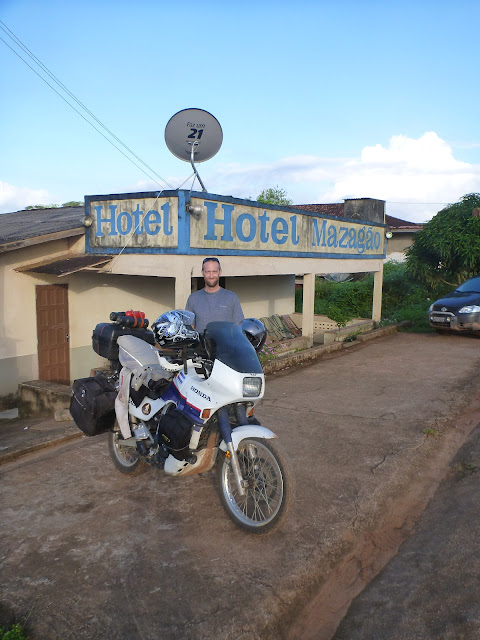

(Our home for the night. A simple little pousada that had a garage for parking, A/C in the room, and free *cold* drinking water. All the little things made the 40Rs worth it)

Tuesday, June 19, 2012

French Guiana...or Guyane...or whatever

The ferry from Albina to St Laurent du Maroni was super easy.  It scheduled to run a few times everyday (only once around 2:30pm on Sundays, usually last boat is around 5pm) and has all the customs and immigration offices right there.  There are also private boats that dock right at the ferry landing, so if you were impatient and felt like bargaining (and lifting a motorcycle into a boat) you can cross whenever you'd like.


(ferry to French Guiana.  They only charged us for the moto at 15 Euro, making Jill and me free (should have been 4 Euros each).  This was the first taste of French Guiana prices)

At immigration in St Laurent, we were stamped in by a national policeman named Phillippe who has a big KTM 950 Adventure bike and has traveled all over South America.  He even hosts some travelers that come through.  He was really nice.  Mostly because he let us through with our questionable insurance document (the only French word that I understood when he spoke with his colleague was "photoshop").  But also because he shared a lot of information about camping in the area and what to expect in Brazil.  That, and he complemented the TA, which always helps.  He likes the exhaust note.


Couchsurfing in St Laurent was a phenomenal success!  Our host, Julien, drove into town to lead us back to his place, which is just a few kilometers south of St Laurent. Right away we knew we’d hit it off with Julien and his roommates Bertrand and Nanou. They cooked up a phenomenal pasta carbonara (but of course denied that it was any work at all) that complemented our Heinekens, Parbos (we thought we were done), and ti punch. It was a very warm welcome to French Guiana.


(Nanou, Bertrand, Julien, Jill, and Mike in St Laurent)

The next day was relaxing. While our hosts offered a few ideas of activities (including the prison that Mike had seen and some waterfalls that sounded okay but would have been a mission to get to) we just relaxed during our day in St Laurent. Until evening time. Then we were engrossed in French culture. Bertrand and Nanou invited us to learn pétanque with them, and a group of 15 or so of their French friends. The game is similar to bocce ball, but played with heavier, lead balls, with the men playing versus the women (note from Jill: the women won).  To complete the culture of pétanque, we played with a cup of pastis in hand, which is a traditional anise flavored liquor from Marseilles. C´est le pastis! A superb way to spend an evening outdoors along the Marrowijne river.

On our way towards Cayenne, we stopped by the beach at Awala to see another area where green and leatherback sea turtles lay eggs. The best time to view turtles is within a couple of hours of high tide, and we were about as far away from that window as you can get. So we didn’t see any turtles. But we did see some evidence.


(broken egg shells on Plage Yalimapo. Unlikely that those were hatched naturally given that it’s still June, but hopefully that’s what happened. Also unlikely that they were poached or else the shell would be gone too. Maybe natural predators?)


(we weren’t the only ones looking down the beach. Unless those cameras are unmonitored Which is a distinct possibility.)

Further down the very well maintained road (is this still South America?) we found an open cafe in Sinnamary, which was more difficult than we expected. Everything was closed. Even the gas station. This country closes down between 12 and 4 every day. (Confirmation that we are, in fact, still in South America.)


((empty) street view in Sinnamary)

Cayenne was a quick stop, where we couchsurfed with our very kind host, Katia. She was great, but Cayenne as a destination, kind of blah. Ever since leaving Paramaribo, Jill’s been saying that French Guiana will be like Suriname but more expensive. I had higher hopes for the road conditions, amenities, all that, but knew that it would be more expensive. It turns out Jill was pretty damn close: we think Cayenne, in general, is equal to Paramaribo plus 25%, but is much more expensive (maybe Paramaribo plus 100%).


(street view in Cayenne)


(old port/pier where we went to see ibis birds)


(ibis flying out to their nests)


(a staple of Cayenne is the street lined with hamburger vendors, open every night, only at night)


(Jill, Katia, and Mike at the vendor we picked to try. We picked well. That madras burger was great, but probably not good enough to get us to plan a trip back to Cayenne…)


(…boxed rum helps, though.)


(sunrise in Cayenne)

Leaving Suriname

It was exhilarating to get back on the bike in Paramaribo!  Leaving that city felt almost the same as leaving Denver over a year ago, especially after the hiatus.  Traveling towards places unkown was a sensation that we had become accustomed to during our previous months on the road - making headway becomes a bit of a daily routine (...on some levels, thankfully we're not talking about too much monotony here...).  But starting to roll again brought back some of that tingling anticipation of not knowing what we'll run across next.  That's an indescribably wonderful sensation!

Before leaving Suriname, we took one short trip back to Drepada, the site where Jill spent her original 2 years of Peace Corps service.  It was a good chance to say goodbye to a couple of her friends from there, and to join some of them for a few too many Parbos in Brokopondo.  It was quite the send off.


(that way to Brokopondo)

The following morning we went to Albina to handle the customs forms for export of the motorcycle.  Even though just 5 years ago the road used to be a reasonable stretch of pavement, somehow "working on" the road has caused morse code-like segments of paved sections followed by rough dirt sections (short-short-long-short-short-long-short-long) with not much warning at the transitions.  Ahhh, right back into South American riding!


(on the way to Albina)

Mike was a little bit worried about the customs paperwork for the motorcycle, as we have a hefty deposit (US$800) that we need to get back.  Staying in Suriname for 6 months complicated the motorcycle import, requiring us to fill out more official import documents than the usual 30-day stamp at the border.  It also required us to put that deposit down.  And it also gave Mike the chance to run around Paramaribo for days on end to sort it all out - which was fine, at least it gave him something to do.  Another errand that took a few days to figure out was getting permission to drive from the National Police.  (For those who may pass through Suriname, don´t worry about that, I think it's only required if you stay in country for more than 14 days or something like that.)

But once we got to Albina, we found the ferry dock right away and were able to get all of our forms stamped, signed, and processed in just a few minutes.  It was the fastest border crossing yet, aside from the 2 hour wait for the ferry.  While it seemed like the officer knew exactly what he was doing, the true test will be whether our deposit is released in the next couple of weeks.  Fingers are crossed...


(customs in Albina, Suriname)

Sunday, June 3, 2012

Final thoughts on Suriname

Suriname is fascinating, silly, frustrating, beautiful, intriguing, hot, dirty, tranquil, … you name it, you can probably find it here.  Unless it’s a specific product that you’re looking for.  Then your probably shit outta luck.

Most of these comments are focused on our time in Tutubuka.  Life in Paramaribo would create a whole new set of thoughts (can you say, customer service?), but those thoughts would be similar to any city in a developing country, so not worth repeating here.

Mike’s Likes
  1. Killing ants (it’s like slow motion whack-a-mole with boiling water instead of a mallet.  But then Jill made me stop because I used too much of our propane to heat water.  Booooooo!).
  2. Killing kosombos, a type of biting fly that leaves a bad bite.  My fondest memory of kosombo killing was in a wagi on the way from Atjoni to Foto.  A guy took off his sandal and chased one fly around the VW van sized wagi until that fly was dead, probably about 10km distance to success. (I really don't like killing things that much, I swear.  It's just that these things are pesky.  Oh yeah, and mosquitoes, too.  I really like killing mosquitoes.  But that's it.)
  3. Randomness.  You never know what's going to happen on any given day, at any given time out in Saramacca.
  4. Saramaccan smiles.  Many Maroons are very serious a lot of the time.  But once you get 'em smiling, it's brilliant.
Jill’s Likes
  1. I loved working with the coop.  I had a lot of fun and developed great relationships with the members.  Plus, being a business advisor for a motivated group like this is something I would like to continue doing.  It was great to see positive improvements throughout the six months.
  2. I like living in the jungle and enjoy village life.  I think Saramaccans are extremely entertaining at all times and they never cease to make me laugh.  Going to work in the fields with the women is something I really value.  Having the chance of seeing random wildlife at any given time was also a plus.  I like eating the food, don't mind the boredom, and the heat doesn't bother me, so Suriname is a good fit for me.
  3. I also enjoyed killing insects of all kinds.  Towards the end of our stay, I became a highly skilled fly killer. My weapon of choice is an old Economist.
  4. I got to read 55 books in 6 months.


(Jill also enjoyed feeding our neighbor's scarlet macaw, Ralph. He came walking by our front door everyday once he figured out how to let himself out of his cage)

Mike’s Not-so-likes
  1. Lack of privacy.  The front door basically has to be open whenever you’re home. Kids come over all the time.  People will watch you eat, maybe asking for some.  If you’re not eating, they may just stare at you.  That’s awkward. 
  2. Lack of politeness (and maybe respect?).  “Dame som” is a very common phrase.  It means “give me some”.  There is really no equivalent for “please” in Saramaccan.  So the lack of politeness is mostly a cultural difference, I know, but seriously, at least ask my name or say something else before asking for whatever happens to be in my hands.
  3. Lack of freedom.  There is very little that you can do to escape the village.  There’s literally only 2 paths that you can walk out of town, you can walk around the village but you know exactly what conversation you will have all over town (Saramaccan greetings and conversations in passing are pretty consistent).
  4. The climate.  Jungle living is not for me.  It’s hot.  All the time.
  5. Dengue.  And giardia.  At the same time.
Jill’s Not-so-likes
  1. No matter how well I know the language, develop relationships in the community, and care about the people, I will always be a bakra, an outsider, a white person with money.
  2. Being sick a couple times in the last month was not much fun.
  3. I don't like Paramaribo very much.
Even with both of our ups and downs while here, we are both very much looking forward to hitting the road again.  I mean, which mode of transportation would you prefer…


(…riding in a container on a truck…)


(…or this fine 1989 Honda Transalp?)

Transalp.  Hands Down.