Sunday, December 4, 2011

Red Road

We knew that the road from Lethem to Georgetown could be hairy, as it is unpaved all the way to Linden, over 300 miles away. So we set out with some food, extra gas, and the expectation to take a couple of days. It did take a couple of days. A couple of long days. But it was suh-weeet!


(last bit of pavement for awhile)

Initially the road is packed fairly well, although there are stretches of bone rattling washboards that you can smooth out with speed, but somehow the stretches change frequency randomly, and the top surface can be a layer of loose red gravel and dust, which just adds to the excitement.


("Caution Bridge Broken Ahead")

Those washboard sections let up after a few tens of kilometers, transitioning into massively large potholes that had a sneaky way of hiding until the last minute, given the shades of the road bed. Some of those potholes were gi-normous! Big enough to swallow us whole.

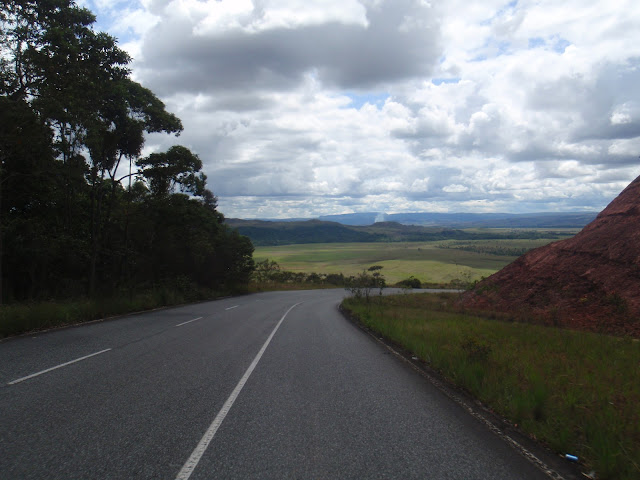
Along the way, we did get to see some amazing natural beauty, including the scenery as it slowly changed from savanna to jungle, as well as a few glimpses of wildlife.


(Termite City was not labeled on our map)


(termite house within termite city)


(Pacaraima mountain range in the distance)

At 70 miles (on the odometer) from Lethem, there is a small community of a few houses. A large property on the left side of the road sells gas for 380 guyanese dollars per liter (US$1.90 per L). We went ahead and topped up while we had the chance. (It turned out to be 215 miles from the gas station in Lethem to the next gas station with a pump.)


(octane rating not provided)


(the bridges were in decent shape, but definitely without guardrails)

We eventually made it to the entrance to the Iwokrama national park, where a police checkpoint just takes down your info, but no fee.


By this point the road had smoothed out a good bit, and the potholes were fewer, as the jungle got denser closer to the river.


We arrived at the Kurupukari ferry crossing just a few km after the turn off for the Iwokrama eco-lodge and after another police checkpoint (again, just taking information, but you have to go inside each time).


(this van, or wagi, is the most common small vehicle on the road. Even more common are the DAF transport trucks)

The hours of operation showed the ferry running until 6pm. It was 5:15 and not much activity was visible, especially with the ferry on the other side of the river. A DAF truck pulled up around 5:30 or so, and eventually called us over to talk. Dino and Kevin were on the 12-14 hour run up to Georgetown and shared some tangerines with us. They make that run 3-4 times per week, pocketing about 10,000 Guyanese dollars per run (US$50). As we were considering returning to camp at the eco lodge, they informed us that the ferry had to run, since his truck got there before 6. Perfect!


(manual ramp on this barge)

We stopped just on the other side to eat dinner at Dorothy's place, along with Dino and Kevin, and to set up camp. Dorothy was so nice that she charged us a few bucks for dinner, but nothing to set up a tent.


(Dorothy, an Amerindian, has been at this spot serving food for decades. Another guest house/restaurant opened up next door to her, but we hope she pulls through)

The next morning we got an early start on a gorgeous day.


(traditional AmerIndian village on the way to Linden)

Once again we had the chance to see some incredible wildlife. The highlight was the tapir, pictured below. We stopped and watched it for a minute as it lumbered slowly into the jungle. We also had a chance to catch a brief glimpse of some kind of cat like creature (sizewise similar to a golden retriever dog), a couple of jungle beavers (I wish I could tell you what they were really), and one dead monkey on the road.


(tapir up ahead. This jungle cow wasn't too bothered by us passing. It's hind quarters were still visible to the side of the road as we passed, but our limited zoom didn't let us get any National Geographic photos.)

The ride towards Linden provided much different road conditions than what we had seen the day before. At the start, the road was packed, surrounded by dense jungle and easy riding.


(the jungle crept in on the sides of the road for most of our ride up to Linden)

There were a number of sections that were super slippery mud, along with some decent puddles and ruts.


(Mike coming through a muddy section)


(Jill was the mud scout when the going looked slippery)


As we got closer to Linden, there was less mud, but a lot more loose bauxite dust on top of the road. There were some short sections where the bottom absolutely dropped out to soft sand. Even though the TA was a bit sideways at a couple of those transitions, we managed to keep the rubber side down this time. Mike is not convinced he's getting better at dual sport riding, but was just evening out his Venezuelan motorcycle karma.


(passing trucks provided a dust bath)


(major logging operations along the way, most of their work is out of sight, this evidence was clearly visible. What about that "no logging" sign earlier in the park?)

There was one last official police checkpoint and one huge Chinese lunch when we left the national park. And then, the sky just opened up on us. We were about 20 km outside of Linden when the downpour began. We kept making slow progress, even though we could hardly tell what the road conditions were going to be - if soft sand was next, or a hard packed rut.

We finally turned towards town, nearing the pavement of Linden, when we encountered our scariest and most unofficial checkpoint yet. In the downpour, a youngman wearing blue fatigues, purple diamond studded sunglasses, combat boots, and carrying an assault rifle waved us to a stop and pointed to the side of the road. Acting confused in our rain soaked state, we pointed ahead to Linden and asked if we could go there. He didn't like that idea, pointing his rifle at us and insisting that we pull over beside the white van. Inside the van there were about 8 officials wearing uniforms and name tags and were not nearly as trigger-happy as the guy with the rifle, which gave us some relief. They asked to see our passports, copies were handed over. They offered a seat in the van, but we told them we were already wet, no big deal, preferring not to get in with any of them, let alone sit next to the rifle toting crazy. After reviewing our copies, they wished us a safe journey and we were on our way. No trouble at all. But definitely a lot of adrenaline.

Speaking Spanish Portuguese

By the time we were finally able to wrap up the customs process in Brasil, it was late in the afternoon and there was no chance of us making it to Boa Vista, our planned next stop. Luckily for us, the town on the border, Pacaraima, was nothing like many border towns we have seen that you want to get out of as quickly as possible. Pacaraima was in fact pleasant, somewhere we actually wouldn't mind spending a little bit of time. It even had information for tourists, souvenir shops, lots of dining options, etc. We found the only hotel in town that was not either full (not quite sure how they were full because there were no other tourists in sight, but there is a larger bus terminal in the town so maybe that brought in guests) or had no secure motorcycle parking.

We walked around the town looking for a place to eat and finally decided on a small restaurant with a very friendly woman owner. She served something like a 3 course meal, complete with salad, steak, rice, beans, coleslaw, etc., for cheap. We loved Brazil so far.

For the past 6 months, we had been getting by quite well with Mike's Spanish, but it was a different story in Brazil. Mike usually started his conversations in Brazil asking if the person understood Spanish, to which they usually replied no, or they could understand some but not speak it. So, we kept speaking Spanish, which got us by, but we could very rarely figure out what the response was. Perhaps surprisingly, despite the border of English-speaking Guyana being so close, no one spoke English.

The next morning we got on the road to head to Boa Vista, about a 2 hour drive. The drive was rather monotonous and the savanna continued throughout.


We arrived in Boa Vista pretty early in the day, so decided to check out several hostel options. The cheapest one we could find was still $35, which was a little outrageous in our opinion. We had a few things we wanted to buy, but we arrived on a Saturday and despite the fact that the town has over 230,000 people and is the only town of size in the area, hardly anything was open. We tried to exchange money, but that ended up being an impossible task as all the money exchanges and gold buyers were closed, so we ended up having to use an ATM. We were staying right downtown, but it seemed like a ghost town. We had planned on staying in Boa Vista through the weekend, but since we didn't want to pay for another night at the hotel and since nothing was going on anyway, we decided to move on to the border on Sunday and see if we could get to Guyana.

The drive to the Guyanese border took a couple more hours, also through relatively boring savanna. We were not sure if the border would be open, but it was no problem. Our only holdup at the border was that the woman at customs did not want to give us a copy of the paperwork showing that we checked the motorcycle out of the country. From our small amount of understanding of Portugese it seemed to us she was arguing against her co-workers, who were telling her to make a copy. Finally, we did get the copy, which we ended up needing in Guyana. Despite the hold up, it still only took a few minutes to get cleared out of Brazil.


(Mike at the customs building in Brazil, note the engine guard bags replaced by 1 gal of fuel each side)

From there we were able to drive across the newly constructed bridge from Brazil to Guyana (until this year you had to take a ferry). You can't miss the immigration building, as the road guides you right into the parking lot. Prior to that though, you have to switch over to the left side of the road, as Guyana operates under the British road system.


(don't forget to switch to the left side of the road!)

Immigration into Guyana was very simple, although they do ask several questions and want to know a specific address where you will be staying in the country, at least they are asking in English. Customs for the bike was not quite so easy, because we needed both insurance for Guyana and copies of documents, including the Brazil document, neither of which we had. The woman was also pretty unhappy that Mike interrupted her nap, so was reluctant to even tell him which copies he needed. She did allow us to take the bike into the nearest town, Lethem, to get things worked out. Not surprisingly, very few stores were open on a Sunday in this already sleepy town, so we needed to spend the night and get copies and insurance the next morning from the Savannah grocery store. One of two hotels in town, the Savannah Inn, was owned by the same person, so we stayed there (US$20 for a fan room) with the promise that the owner would be there by 8 am ready to help us.

(There is another hotel in Lethem that is a ripoff - the Takutu Inn. Our first meal in Guyana was there - country stew. Random bits of white, fatty bush meat and innerds in a bland broth for 850 guyanese dollars (over US$4) each. And internet access there was US$2.50/hour, 3x as much as most places. Go with Savannah Inn.)


(almost all offices, lobbies, hotels in the area had out hot water, tea, and coffee all the time. Even Brazilian customs office at the border.)

By 8:30am, we had our insurance in hand (US$15 for 1 month), along with plenty of copies, and went back to customs where we received 2 important documents this time:  temporary vehicle import and a driving permit.  Both were free.  And both needed a Guyana address, so have a hotel and address in mind if traveling through.

la Gran Sabana

Our big goal after Lechería was to make the Brazil border, but that was over 12 hours away, so a couple nights along the road broke it up, as well as a couple of good meals. 


(the best filled arepa yet - filled with pabellón, the semi-offical national dish of Venezuela with rice, beans, and shredded beef or pork - on our way out of Lechería)

We spent one night in Puerto Ordaz, a very modern city, with very few hotels that met our criteria (cheap with good parking).  Asking at a corner store we were directed to a small guesthouse with 2 rooms for rent.  Casa de los Lobos was a fine place to crash, but left us feeling slimy after seeing the older German man who owned the place, along with his 2 young daughters and his too young Venezuelan wife.  While there, though, we did have the chance to try hallaca, a traditional Venezuelan dish usually eaten around Christmas time that contains meat and veggies surrounded by cornmeal then wrapped in plaintain leaves and cooked to deliciousness.


(Chavez loves creepy looking babies)

The next day we were shooting for at least Km 88, perhaps Sta Elena, both places where we knew we'd be able to find lodging. The ride was gorgeous and desolate.


The front end of the bike was still feeling strange, beyond that of just having a slight twist in the assembly. Checking the front wheel for play, it was clear that one or both bearings were shot, in the middle of nowhere, south of Puerto Ordaz. We limped to the next little town, Guasapati, where we filled up on gas and asked about motorcycle shops. Turns out there was a guy on an ATV at an unmarked blue door just 2 buildings away and that's who we should talk to. He was the right guy. We followed him 2 more blocks to his shop and had new front bearings installed within the half hour.


Back on the open road in much better shape than before.


(shadows got longer as the day went on)

Down the road in El Dorado we went to fill up some more cheap gas. Cars were parked for 3 blocks waiting to get gas (common at gas stations out of the big coastal cities). Motorcycles were lined up on the exit side, waiting their turn to get filled between car fillings. The armed guards (common at gas stations) waved us to the moto side, and even waved us in front of the waiting crowd of 15-20 bikes. We filled up for a few cents and hit the road. Most motos don't pay for their gas, only filling up a few liters into their small tanks. We ended up giving 2 Bolívares (US$0.24) to cover gas and a tip on most fillings in Venezuela.


When we arrived at Km 88 (that's how the town is even labeled on Venezuelan road maps), we decided to call it a day and find a place to crash. We ended up asking in all the hotels in town, finding each of them to be overpriced for what they offered. Most were 250-300 Bolívares (US$30-35). Even the places labeled as campamentos. There was one campamento that had an airconditioned room for 200 Bs, and secure parking. The town was a bit rough around the edges, we received some tougher stares than other places in Venezuela, but still everyone we talked to was friendly and warm.

Leaving Km 88 was a tight, winding, mountanious road up into Canaima National Park and to the Gran Sabana. The road takes you up 1500 meters to a gorgeous open expanse that would be a blast to return to and explore. There are some great dual sport options to check out lots of waterfalls (a few 4x4 tours run in the area) and a number of places to camp along the road.  Santa Elena would be another good option for a place to stay and take day trips.


There was one police checkpoint, where the cop was on a power trip, but was still easy enough to get through.  There was one military checkpoint when we were getting closer to Sta Elena.  The military guys there were fantastic, asking us a few questions, letting us know a bit of what's ahead, and then sending us on our way.  Best of all is that one of them came running out of his office, shouting and waving at us as we had just begun to roll slowly to remind us that we had to turn in our temporary import permit for the bike.  Not that we'd forget by now, but still nice of him to think of it and catch us.


Santa Elena de Uairen was a very inviting town, not having the usual border town grit.  We just traveled on through, but would have easily found food and lodging there, as well as hardware and moto shops.  Out of town about 15 km, we made it to the border.


(leaving Venezuela. Office at left is both migration (in main doors to right) and SENIAT/customs (in main doors to left))

The bike was checked out within minutes, after lunch break was over at 1pm.  Migration, however, required us to wait for over 2 hours just for the officer to show up to work.  There were around 4 groups of people in line ahead of us, and by the time we got stamped out, there were 50 people waiting for one officer.  Impressively, a line was actually formed and maintained (with some vocal reminders directed at a few wanderers).  We were happy to get out of there when we did, and hoped that the Brasil side would still be open.

At the Brasilian gate, migration is handled by the federal police office in the first building you will come to on the left (follow the signs).  They were friendly and fast, refreshing after our Venezuelan departure.  Up ahead about 3 or 4 speed bumps is the customs window.  The lady that helped us didn't speak any English or Spanish, and my Portugues includes all of "bom gia" and "obrigado", so the process was slowed some by communication.  But worse than that, the officer had seemingly never been through the temporary import process before.  There were long stretches of her staring blankly at the computer screen and forms, hoping issues would resolve themselves. 


(dealing with customs entering Brasil)

After I got the appropriate copies made (about 2 or 3 blocks down, on the main street to the left, there is a copy shop on the right, directly across from a tourism office and small mall), and a few Bs exchanged, the process still took about 40 minutes.  But finally it was done and we were happy to be in Pacaraima, Brasil!

Milkin' it in Lechería

Our couchsurfing hosts in Lechería were Ricardo and his soon to be wife, Suzy.  Ricardo had gone to culinary school in Florida, so his English was perfect and we were pleasantly surprised by his making us gourmet pizza on our first night.  Suzy works for the oil company in town (used to be a few more oil companies in town, now PDVSA is the one...), so has more of a 9-5 type job, and got to practice her English with us (it is a lot better than she thinks it is).  They also have a wonderfully psychotic cat that seems to be in constant motion and were dog sitting for a 2 year old pug that seems to have a knack for always being the center of attention.  The cat hates the dog, so that made it even more fun. 

Luckily for us, Ricardo's work schedule is pretty flexible right now, so we were able to hang out with him quite a bit and he took us around the area.  Lecheria used to be a lazy fishing town, at some point was a milk producing area (hence the name) for the bigger city of Barcelona, but has now developed into a very modern city.  It is attached geographically to three other cities, Barcelona, Puerto la Cruz, and Guanta.  Together they are one of the most important urban areas in Venezuela and have almost a million people.  Barcelona is the oldest city and has a mix of old architecture and new.  Puerto la Cruz was developed more recently, but has the look of South Beach. 

Ricardo took us touring around the cities on our second day there, with our first stop at Cerro Morro, a hill that is apparently sinking, the site of the old fortress.  Many luxory hotels and tourist places were built here, but are not doing so great right now.  It is also a place that teens go to drink and make out.  Ricardo said there has been a rise in crime there in the evenings.  From the top, there is a beautiful view of the ocean on one side, and Lechería on the other.


He also took us to Puerto la Cruz to do some shopping, and there is shopping of all kinds to be done there.  Also, not a place that Ricardo wanted to be with two gringos at night.  We were able to find a few things we needed for the bike (new multimeter to replace one damaged in crash), and Ricardo found some nice knockoff sunglasses.


By the time we left, it was getting dark and was time to pick up Suzy from work.  From there, we went to an awesome local Lebanese outdoor restaurant that seems to be full of people at all times, and for good reason.  We got the platter, which easily fed the four of us, even though Ricardo takes pride in having once won a pizza eating contest in which he ate over 20 slices of pizza.


(Jill, Suzy and Ricardo excited about dinner)

We were sad to again have to leave after only 2 days, but needed to keep moving to stay on our schedule of getting to Suriname by Thanksgiving.  After staying with 3 couchsurfing hosts in a row across Venezuela, we were on our own again through the rest of the country and beyond.  We thoroughly enjoyed our time spent at  each place, but we were both also ready to be independent again, too.  It takes a lot of energy to ride the long days we were putting in and then be cheerful and entertaining to new hosts all the time.  From now on, we will probably split up our time spent with hosts and time spent by ourselves more equally.