Tuesday, March 13, 2012

Suriname update - another of many

Random events in Tutu keep the days moving along. For instance, Josh, a Peace Corps volunteer who has been in Tutu for almost 2 years, needed a new roof on his gangasa, or cookhouse. Helping out/watching provided almost a full day of entertainment.


(roof work party lashing dried, folded leaves in place)


(These guys showed up prepared with a boombox, some fried dough, and a couple of j's (I guess you gotta entertain yourself somehow if you are tying leaves all day long))


(Our job was an easy one since they had already collected all of these vines and had them soaking.  We helped peel the bark off the entire length of each vine (~5m))


(Edwin preparing vines for lashing by splitting it into 4 or 5 individual strands)


(One side of the roof nearing completion. The final cap on the roof is placed with a different type of leaf, but no final picture. You'll just have to believe me for now)

Other highlights come for us when we get to go into the big city every month or so. One of our favorite evenings was when we met up with some of our friends for a sweet dinner in Foto!


(Mike, Cabrini, Cameron, and Deb enjoying some pie and wine in Foto)

To provide you with some of the randomness that keeps us going:


(These grasshoppers have nothing to do with anything. But they provided a good break in the day.)

Grasshoppers are much more pleasant to come across than gross tube worm thingies that put worms in your foot if you step on them.


While on random animal pictures, these fuzzy creatures (below) are everywhere, often where you'd least expect them. At least they only make you itch if you touch 'em

Friday, March 9, 2012

Holidays in Tutu

Tutubuka is considered to be a Christian village. Church is attended frequently, especially around funerals and holidays. Sadly, funerals in Tutu are much more common than holidays.


(funeral procession of men close to the deceased going to burial ground downriver. This is after days of mourning, staying up all night each night, and some ceremonies. The eighth day after death is also recognized, as well as 6 weeks after. Funerals and grieving are especially important to all community members, often due to close family ties.)

Holidays are also recognized by the entire community. Often by attending church for a very long time. We're talking hours on end.


(this is the entry to the church in Tutu)


(Christmas service with everyone in their finest whites)

But most holiday traditions take place as part of the daily routine. Just like the "odi", or greetings, that people must exchange in passing, "Bedake" (= Merry Christmas) is said to all, even those people that are partially hidden in a house, around a corner, not paying attention to you...literally all people...to a comical extent at times. The best part about the Bedake exchange is the delivery - you gotta say it to the other person faster and more times than they can deliver to you. Often people get out a solid 3 or 4 Bedakes before they realize that you are also saying Bedake and that their message has made it through. It's much more fun than the comparatively solemn "Merry Christmas" exchange that we are so used to.

Saramaccan women love to cook.  One of their specialties is cassava bread made from bitter cassava.  Interestingly, cassava roots contain cyanide, so must be prepared properly.  After pulling them up, they are roughly chopped, then ground/grated into small pieces.  Next they are all placed into a long, thin basket
(metape) to allow all of the cyanide-containing water to drain out:


Once the dried cassava is ready, it is poured onto a flat hot plate to cook on a wood fire:


Each women has her own designs that she traces into the bread:


There is plenty of cassava bread to go around during the holidays.  Plenty.  More than enough.  That stuff is sooo dry, kind of bland with a hint of bitterness, and will make your stomach hurt real bad if you eat too much of it (mmmmmm....cyanide...).  But they love it.

Between Christmas and New Year's there was a traveling group of singing children, as well as a traveling drum circle.


New Year's also includes festive odi exchanges for yai, or "year". Customary is a long duration handshake with multiple yai's between two people, and the yai's continue as the handshake is brought up above head height, then unlocked with a final yai-ooooo yai, followed by much smiling and laughter.

Around the 1st, people generally wash with a particular type of leaf purported to cleanse the last year from you and bring good luck for the new year.


On the 1st, everyone dresses in their New Year's finest.


(Jan 1st, 2012 - Jill in her kousu and hangisa, wrapped around the waist as a sign that she has a man. The women in Tutu were insistent that Jill wear one, especially with all the out of towners in Tutu for the holidays. They're looking out.  Mike was lent this traditionally cross stitched banjakoto for the day. It was somehow still that white when he returned it)

Much of NYE we spent at our place with toasts of Borgoe rum, and the traditional lizard dropping from the ceiling (analogous to the old fashioned ball drop).  The village was relatively sleepy until midnight (in fact, most were at church since 8 in the evening...), but at midnight, a container's worth of fireworks were going off in all directions.  Kids were mostly in charge of the mayhem, and absolutely loving it.


(this lizard did not drop from the ceiling on New Years.  This one's just really ugly)

The real parties picked up on the 1st (much more so than the night of the 31st) and continued through the whole month of January.  That's a fun tradition - to extend the celebration.  At a "tapa yai" (= end the new year party's) party on the last few days of January live bands played in the town hall with most of Tutu/Tjai in attendance.   An all night shindig.  Not a bad way to bring in 2012, no matter what the date.

Some people tended to get more than just a buzz on during the holidays.  And sometimes they just need a hug.


(you never know until the shutter releases what type of pose a Saramaccan has in mind for a picture)

Thursday, March 8, 2012

Foto to Tutu

While still in Paramaribo (or Foto) after Jill had moved to Tutu (due to motorcycle import), Mike couchsurfed for a couple of nights with Peter, a Belgian working with the European Union. It was interesting to hear some of his stories of life in Foto, including one in which his phone line had been physically cut, apparently in direct response to a phone call regarding late night noise from his neighbors. Since Peter was at work during the day, I waited at his place for the TeleSur repair men to show up. They said they would be there between 9 and 10, and actually arrived early. After fixing the line itself, I asked about Peter's modem. The repairman took the modem into a specialist at his office. When I asked him how long they would have the modem for, he looked at me like I was crazy, that he would drive right back with it. Sure enough, he returned within the hour with a solution. So, while living in Suriname you may have your phone line cut (not common in the states, unless you find yourself about 40 minutes into a scary movie), you may also expect to have a repairman show up early to completely resolve all of your issues (not common in the states, either).

Finally, I was able to arrange his transport to Tutu. Thankfully, we had previously met a wagi (name for the van/buses) driver through a PC volunteer, so was able to arrange a ride to Atjoni, and Jill had coordinated with a specific boatman.  It all worked smooth, even with some last minute driver changes, some gesturized haggling in broken English, and lots of stops along the way out of town.  2-3 hours later we arrived at the boat landing at Atjoni.


The 1-1.5 hour boat ride from Atjoni upstream to Tutu along the Upper Suriname River is beautiful.


(this is the well-manicured tourist camp Anaula. Most of the tourists that visit the women's shop in Tutu come from Anaula)


(every 15 minutes or so there is another small village along the Upper Suriname, where the usual scene consists of women washing clothes and dishes for their family)


(almost as frequent are cell phone towers. The reception along the river itself and in many villages is incredibly good - better than my old house in Denver!)


(Jill took this shot while walking around a section of rapids where the water was low enough to require emptying the canoes of people and goods)


(arriving at Tjaikondre, the village that is literally surrounded by Tutu)

Suriname update - 1 of a few

So, it's been a few months but we are finally getting updates posted from our time in Suriname so far.  Mostly, we've been living the village life in Tutubuka with short, few day trips into Paramaribo for resupply and meetings.  Overall, Jill's been enjoying her return to Saramacca, boosted by the great group of women she most closely works with, and Mike has also been having a good time while attempting to learn Saramaccan.

Following (in this post and next ones) are some observations from our time here in Suriname, mostly from Mike's rookie perspective.

Daily Life in Tutu

We lucked out and have a nice, well-constructed (= fewer critters inside), rather tall (= less crouching), 2 room house to live in.  Pretty simple, pretty comfortable.


After the first week of walking across town to use a latrine (sometimes 5 minutes can be too far...), we now even have a new pit latrine right out our back door.
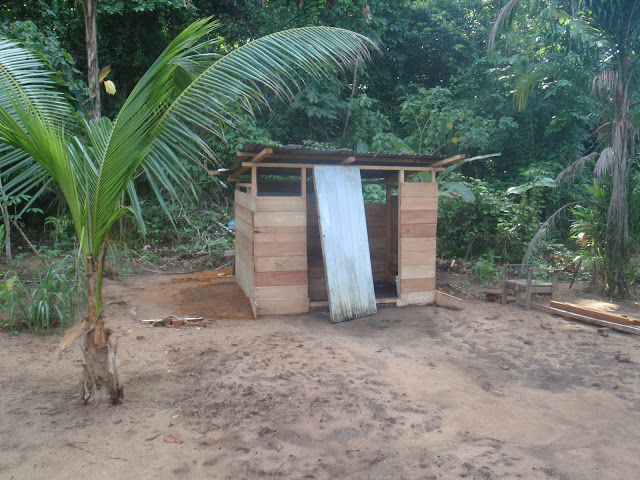

(it's the little things in life that can make a big difference)

Our daily routine generally consists of waking up around daybreak (give or take an hour), working out, eating some sort of simple breakfast (often involving peanut butter), then going to the creek to wash dishes, clothes, and ourselves.


(the rocks are useful for washing clothes, setting down dishes, and for the random kid rock jump.  It's only a few feet deep so we don't do too much jumping)

(looking the other way down the creek)

Traditionally, women carry heavy loads on their heads, a skill that Jill picked up while living here previously.  She's still got it!


Back at the house, it's usually time to start cooking lunch (and dinner, cooking enough at once to get 2 meals out of it).  Most of the time rice with veggies are in store, assuming we have some from the city (stay good around 1 week) or have earned some by going to ground to work the fields with some ladies.  Jill is much better about earning veggies than Mike.  She likes weeding and loves to get out into the jungle.  I don't mind labor, but weeding is just not my thing (especially in a jungle, where pulling weeds seems incredibly futile).  That attitude (of me trying to get out of important labor) fits with the usual gender roles within Saramaccan culture.  That's about the only gender role that fits so well...


(the trail back to Resida's ground)

(an overview of her area to be worked/planted)


(Resida pickin' the goods)

 
(it was watermelon season during January, and when it's watermelon season, it's WATERMELON season. There is an excess of watermelons everywhere with a surprising lack of variety of other fruit/veggies available at the time. For the jungle being so conducive to plant growth, not many fruit/veggie options at any given time)

Saramaccans find it hysterical that Mike helps with dish/clothes washing chores.  A few women at the creek have positive comments regarding me helping out, but usually people are perplexed by why the man of the relationship would do such a thing.  And when Bai's father found out that Mike cooked breaded fish that he tried, he laughed out loud for a good 10 minutes.  It really doesn't help Mike's case that he goes to the jungle without a gun, helps out at ground, washes dishes/clothes, etc.  Men don't do any of that.  Men go to the jungle to hunt for meat.  And sometimes they're successful.

In the past few months there have been 3 tapirs killed by people in Tjaicondre (neighboring village) and Tutubuka.  There are some traditions/rituals practiced at the kill site, but then the animal is brought back to the village to be parted out to all (or mostly all).  The hunter and his family receive a large portion and then other pieces are doled out.

(the hunter taking his portion of bofo, or tapir, back to his family. Most they will eat, some of it they will sell to other people around town who didn't get their own portion)

(the butchering and parting in progress)


(the only evidence remaining after less than 2 hours!)

Saramaccans generally share their food within the community.  As mentioned, food is a common form of payment for helping out.  Also, "living well" with the community often means that you cook up a dish and share portions with your friends and neighbors.  (However, some friends and neighbors are better than others at keeping that a 2-way street.)  It is also completely acceptable to ask for food from anyone eating.  Often times people eating something as we are walking past will offer us a spoonful to try.

Along a similar line of sharing, Saramaccans are very used to sharing their space.  Private space is minimal.  Everyone's door is open as soon as they wake up, only closing when they are away from home or sleeping.  Sometimes that can be fantastic, sometimes very overwhelming.  It's usually the more calm times that we're able to get a couple of pictures.


Some other Highlights of Daily Life:
Electricity generally comes on daily from 7pm to 11pm.  Otherwise it's really dark and hard for both Jill and me to read by candlelight.


Soccer games on Sunday - teams come from neighboring villages on the river to play soccer, complete with jerseys, refs, and cold beer for the spectators.


Towels are acceptable attire - usually only in the "neighborhood" around your own house, but how great is that?!?